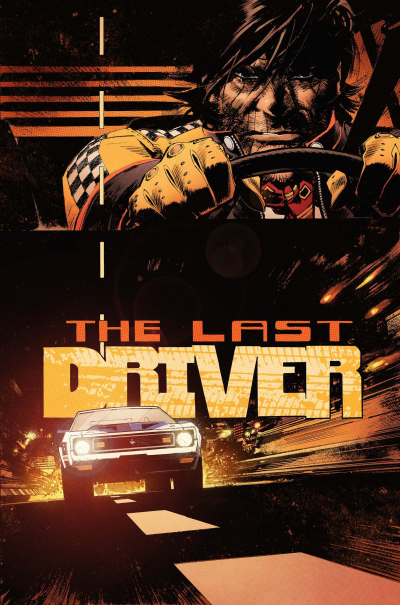
Sean Gordon Murphy has always pushed against the mainstream.
The writer and artist built a reputation with bold creator-owned projects like Punk Rock Jesus, the provocative series published through DC Vertigo that centered on a clone of Jesus Christ. Even his superhero work carried an outsider edge. His breakout hit Batman: White Knight became an unexpected franchise success for DC Comics while operating far outside traditional Batman storytelling.
Now Murphy is returning to creator-owned comics for the first time in nearly 12 years with a new series built around rebellion, dystopia, and his longtime obsession with cars.
New Series Launches This August
Murphy has written and illustrated The Last Driver, a new ongoing series set to debut in August from Image Comics.
The cyberpunk action story draws inspiration from Escape from New York and the cult road movie Vanishing Point. Murphy is also experimenting with the comic’s presentation. The Last Driver will use a landscape format designed to be read horizontally, a style rarely seen in modern comics publishing.
The Story Behind The Last Driver
The series takes place in a future America where advancing technology has transformed transportation. Cities now rely on the Grid, a robotic transit system that has made traditional cars obsolete and illegal.
At the center of the story is an outlaw named Clutch, who is forced back behind the wheel to save his granddaughter’s life. What begins as a desperate mission evolves into a larger rebellion against technology, fascism, and the growing divide across America.
Sean Gordon Murphy said the idea came to him while visiting France and seeing historic race cars stored in an unexpected setting.
“I was in France when I started to think of this book, at the race track at Le Mans,” Murphy wrote in an email. “The museum was doing construction, so they moved about a billion dollars worth of cars to a nearby hangar located in a cow pasture. It was an amazing sight! And it made me wonder who was going to take care of such valuable cars in the future. Not just race cars, but movie cars.”
Cars as a Metaphor
Murphy said the project gave him a chance to combine his love of drawing vehicles with larger themes about technology and control.
“Not only would this story be an excuse to draw cars, but I could compare the dying of car culture, switching to electric cars that drive themselves, and use it as a metaphor for people ceding control to government control,” he explained.
Murphy also wanted the story’s lead character to reflect themes of freedom and cultural loss.
“For America, I wanted the main character to be Native American. Someone who understands freedom in a different way, because of how it was taken from him,” Murphy wrote.
A Passion for Vehicles
Murphy’s fascination with vehicles extends well beyond comics. The artist described himself as deeply connected to car culture and the experience of driving.
He also acknowledged that many artists avoid drawing vehicles because of the technical demands involved.
“I love the technical challenge,” Murphy said. “It’s gotten me a few gigs outside of comics as well. From Harley Davidson to designing vehicles for Warner Bros.”
Murphy’s love of cars also shows up in his personal life. The cartoonist owns a restored and modified 1978 Datsun that he regularly takes to car shows. According to Murphy, the vehicle has already won two awards for best 1970s muscle car.
“A Japanese car winning that award usually annoys the traditional American muscle car guys,” he said.